Monday, November 16, 2015

Bibliophile's Corner...with an Interview & Giveaway!

 
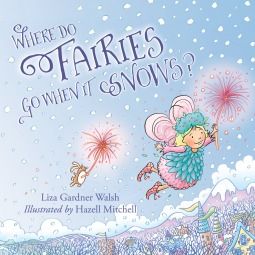
Where Do Fairies Go When It Snows?
by Liza Gardner Walsh
Illustrated by Hazel Mitchell

Book Description:
Everyone knows fairies love spring flowers and summer sun, but what happens when autumn comes and the days get shorter and colder? Now, Liza Gardner Walsh, acclaimed author of the Fairy House Handbook and Fairy Garden Handbook, explores the matter in a charming children's picture book of rhyming questions. Combined with delightful illustrations by Hazel Mitchell this whimsical book will help children discover just where fairies go when it snows and offer a subtle lesson about the importance of helping one another.

Today I'm thrilled to have both the author - Liza Gardner Walsh - and the illustrator - Hazel Mitchell - as my guests on Writ of Whimsy!
We'll be discussing their delightful, recently released picture book:
                Where Do Fairies Go When It Snows?

Before we dive into the interview (and the giveaway!) here is a brief bio/background of each of these talented and accomplished artists:

Liza Gardner Walsh
is the author of four books, Fairy House Handbook, Fairy Garden Handbook, Haunted Fort, and The Maine Coon Cat. She is a high school English teacher and has worked as a children’s librarian, writing tutor, museum educator, and holds an MFA in writing from Vermont College. 
Hazel Mitchell
Drawing, reading and horses were my big passions as a youngster. After I attended art college in my home country of England, I ran away to sea and joined the Royal Navy. Now I'm doing what I've always dreamed of - illustrating and writing children's books.

Welcome to Writ of Whimsy, ladies! I'm so excited to be able to interview both of you. I hope you don't mind, but I'll be bouncing back and forth between you two with questions. So, here we go!

VL - Since I've already purchased and read the book, Liza, I just want to say how much I love it! When did you start writing picture books?

LGW - Oh my goodness, thank you so much! This is actually my first official published picture book, although I have written several other non-fiction books for kids.

VL - Thanks, Liza. Hazel, I've admired your illustrations for some time; however, your work on this book is extraordinary. How long have you been illustrating books for children?

HM - Thanks so much, Victoria! I illustrated my first book (How To Talk To An Autistic Kid) in 2010 and have been lucky to be working on one book or another ever since! Before I illustrated for children I did commercial art work and graphic design.

VL - Gosh, I didn't know that, Hazel. I'll have to take a look at that book, too. Liza, what inspired you to write Where Do Fairies Go When It Snows?

LGW - I have led a number of fairy programs over the last few years and one of my favorite parts is listening to the questions children ask about the unknown possibilities in the fairy world. I have developed that habit too and one day, while I was walking in the snow, I wondered if the fairies hung around during the winter and those questions formed the framework of the book.

VL - I love to hear where authors find their inspiration. Thanks, Liza. So Hazel, you're the first illustrator I've interviewed! Could you briefly explain the steps you took in creating the illustrations for this book?

HM - Illustrators can be tricksey! The first thing I do when I am asked to illustrate a book is read through the manuscript several times to get a feel for the language/mood/character/setting. I think about what age of child it is aimed for and if the words are suggesting a particular style. Sometimes I make a mood board for the book. I think about where the page turns in the book might be. Usually I will begin with sketching the main characters and decide if they are human or animal! Sometimes I use models. With 'Where Do Fairies Go When It Snows?' it was pretty easy...they were fairies! When the characters are shaped I create 'thumbnails', very small drawings that are really just little scrawls of what's happening on every page, at this stage everything can change. Next I will work the scrawls up into bigger sketches of each page, still very loose and sketchy. If I'm happy with them I'll then send then to the art director/editor and they'll give me their input...at this stage the author will usually see them too and pass any comments to the editor. (Not to me directly.) We might have another revision (or two!)...and then it's on to the final art, which can take anything from a couple of months to a year depending on detail and length of book. There will be a final check over that everything is ok, maybe a few tweaks and VOILA! It's a book!

VL - Thanks, Hazel. I loved getting a behind the scenes description of how you approach your work. Now another question for Liza. I know writing a picture book in rhyme is not easy, at least not to do well. Your text in rhyme in this book is exquisite; what is your secret?

LGW - Thank you again! I adore poetry and like to read poems before I write. I majored in creative writing with an emphasis on poetry in college and to this day, I spend much of my time making silly rhymes about our daily life - often to the horror of my family, I even add a tune!
When I was working on this book, there were a few clunkers and so I just kept going over it until I could get it just right. As with most writing, revision is the secret!

VL - I love the word clunkers, Liza. But I agree, they're not cool in our writing. So Hazel, what advice would you give novice illustrators of children's books?

HM - Know your craft. The basics of drawing and creating art are essential. And then you need to supplement this with a good understanding of children's books and how they work in today's market. If you can study at a good college in children's illustration, that's a great place to start. There are part-time courses and some fantastic books on illustrating for children. I would suggest you join the Society of Children's Book Writers and Illustrators and go to conferences that are held by the SCBWI; the Highlights Foundation in PA also has wonderful courses. Harold Underdown (children's book editor) has a  website www.underdown.org that has great information for those just getting started and for those who are working in the field. Most importantly READ a great many books and keep up with what's new from publishers. And DRAW! Always DRAW!

VL - Thanks for those great tips, Hazel. So Liza, what one thing would surprise me about you?

LGW - I am not a terribly surprising person but kids are often quite shocked that I have never seen a fairy.

VL - It sounds like your stories are super believable, Liza!
Hazel, I know you reside in Maine, but hail from Great Britain; what brought you to the States?

HM - Easy question - my husband is American and I moved here in 2000 to be with him. I do love Maine, it reminds me very much of Yorkshire where I come from in the UK.

Well, thanks so much for your time, Liza and Hazel. Your answers were fascinating, as well as informative. I wish we could chat all day!

                                    *     *     *     *     *     *     *

Liza and Hazel are offering a special giveaway today! One copy of Where Do Fairies Go When It Snows? as well as this whimsical Fairy Kit to one lucky person who leaves a comment on this post.
                                               Good Luck!
                                               (The winner to be selected by Liza and Hazel.)


Here are the online links where you can visit Liza Gardner Walsh:
 
 
Here are the online links where you can visit Hazel Mitchell:
 
Website     Facebook     Twitter  
 
Here are the buy links for Where Do Fairies Go When It Snows?:
 
 
Thanks for stopping by Writ of Whimsy!

Friday, November 13, 2015

Champions of Creativity

 
               Astrid Lindgren

For some time now I've wanted to feature a post about this iconic and enormously inspirational children's author. Like so many children, I grew up reading Pippi Longstocking books, and loved them. However, it wasn't until I was an adult - and learned of Ms. Lindgren's personal life - that I became a true fan not only of her work, but of her life. Since tomorrow marks her birthday, today is a good time for this post.


When I began to seriously research Astrid Lindgren's life, I quickly discovered a wonderful website dedicated to everything about the author. So much so, that any attempt on my part to honor her would pale in comparison. Therefore, I'll just tell you why she's been so inspirational to me. (That website's link is at the bottom of this post.)

As I mentioned above, Astrid (Ericcson) Lindgren was born on November 14, 1907, on a farm in Nas, near Vimmerby, Sweden.

Astrid Lindgren's childhood home.

The Ericcson family home is still intact and is open for guided tours year-round.The Lindgren family recently announced that Astrid's Stockholm apartment (where she wrote Pippi Longstocking) will also be open to the public - as a museum - beginning tomorrow. Click here.

After Astrid Lindgren graduated from school she found employment at a newspaper in Vimmerby. She was in a relationship with the editor, and then became pregnant in 1926. Although the man proposed marriage, Ms. Lindgren declined. She moved to Stockholm, became a typist and a stenographer, and soon thereafter gave birth to a son - Lars - in Copenhagen, Denmark, leaving him in the care of a foster family. She continued to work in Stockholm, and although she made very little money, spent most of her weekends traveling to Copenhagen to see her son. Eventually she was able to bring Lars home to live with her in Stockholm. She married Sture Lindgren in 1931 and three years later had a daughter - Karin. Like so many authors before her, Ms. Lindgren made up a story for her daughter when the child was sick - that story was Pippi Longstocking. The book went on to be translated into sixty languages, and is still a popular classic today. Astrid Lindgren wrote numerous other books, essays, and magazine articles. She also received many prestigious literary awards during her lifetime.

Astrid Lindgren was well known both for her support for children's and animal rights and for her opposition to corporal punishment. In 1994, she received the Right Livelihood Award, "...For her commitment to justice, non-violence and understanding of minorities as well as her love and caring for nature."

Throughout her life Astrid Lindgren strove to make good decisions, even when it was difficult to do so...and would require a sacrifice on her part. I think that's what I admire most about the amazing woman. Before her death on January 28, 2002 she was nearly blind.

(Click here for the link I promised to the website on Astrid Lindgren.)

A childhood without books - that would be no childhood at all. That would be like being shut out from the enchanted place where you can go and find the rarest kind of joy.  ~ Astrid Lindgren


Wednesday, November 11, 2015

Whimsical Word of the Week

Fealty - (n.)
intense loyalty; fidelity
Example: Each year on November 11th we're reminded to thank all U.S. veterans for their fealty to our country.

Monday, November 9, 2015

Bibliophile's Corner

On a Beam of Light
A Story of Albert Einstein
Written by Jennifer Berne
Illustrated by Vladimir Radunsky

Amazon Description:
A boy rides a bicycle down a dusty road. But in his mind, he envisions himself traveling at a speed beyond imagining, on a beam of light. This brilliant mind will one day offer up some of the most revolutionary ideas ever conceived. From a boy endlessly fascinated by the wonders around him, Albert Einstein ultimately grows into a man of genius recognized the world over for profoundly illuminating our understanding of the universe.

My Thoughts:
What I found most meaningful in this delightful picture book was how the author revealed the strange childhood of the famed physicist. Ms. Berne went on to include a bit more about Einstein's personal life when she mentioned his hobbies of sailing, bicycling, and playing his violin. While his scientific achievements are included in this well-written book, it is the curiosity and imagination of Albert Einstein that I took away from it. In addition to that, the light-hearted illustrations by Vladimir Radunsky are just lovely. And, for the more serious mind, at the back of the book there is a detailed list of the iconic scientist's experiments, discoveries, and political persuasion. There is a even a book list for readers who would like to learn more about the man who lived life so wholeheartedly. I highly recommend On a Beam of Light - A Story of Albert Einstein to children of all ages!

Click here to learn more about the author, Jennifer Berne.

Friday, November 6, 2015

Storyteller's Journey

Photo Credit: Public Domain
The Wellspring of Curiosity

Somewhere along my path as a poet/writer, I discovered I've always had a story floating around inside my soul - usually numerous tales. However, I've met writers who claim to have difficulty discovering an idea worthy to be developed into a book.
Why is that? There are probably numerous reasons, but the one that I believe is the missing ingredient to inspiration is: CURIOSITY.

Curiosity is a trait that is found in children in abundance, and also in adults who have maintained a childlike outlook on life. So why do some adults so quickly discard that mindset? One reason is that it doesn't seem sophisticated enough for the likes of an intellectual or an author.

However, if we writers want to pen something that is not only worthy of publication, but will also satisfy our own soul, it behooves us to tap into the wellspring of curiosity. Only then will we find a subject that is important to us, and will therefore matter to our prospective readers.

Below is a list of quotes on curiosity by some truly gifted people: 

"Curiosity is lying in wait for every secret." ~ Ralph Waldo Emerson

"We keep moving forward, opening new doors, and doing new things, because we're curious and curiosity keeps leading us down new paths." ~ Walt Disney

"Once we believe in ourselves, we can risk curiosity, wonder, spontaneous delight, or any experience that reveals the human spirit. " ~ e.e. cummings

"The important thing is not to stop questioning. Curiosity has its own reason for existing." ~ Albert Einstein

"Curiosity is one of the permanent and certain characteristics of a vigorous mind." ~ Samuel Johnson

"I think, at a child's birth, if a mother could ask a fairy godmother to endow it with the most useful gift, that gift would be curiosity."
~ Eleanor Roosevelt

"Curiosity about life in all of its aspects, I think, is still the secret of great creative people." ~ Leo Burnett

This topic has always interested me, but when I read the new book: Big Magic - Creative Living Beyond Fear, by Elizabeth Gilbert, I was reminded of the importance of curiosity. It's a must read for all writers!

Wednesday, November 4, 2015

Whimsical Word of the Week

Bailiwick (n.)

one's sphere of operations or particular area of interest.
Example: The English teacher refused to teach mathematics; it just wasn't in her bailiwick.

Monday, November 2, 2015

Bibliophile's Corner

Crenshaw
by Katherine Applegate

Flap Copy Description:
In her first novel since winning the Newbery Medal, Katherine Applegate delivers an unforgettable and magical story about family, friendship, and resilience.

Jackson and his family have fallen on hard times. There's no more money for rent. And not much for food, either. His parents, his little sister, and their dog may have to live in their minivan. Again.

Crenshaw is a cat. He's large, he's outspoken, and he's imaginary. He has come back into Jackson's life to help him. But is an imaginary friend enough to save this family from losing everything?

Beloved author Katherine Applegate proves in unexpected ways that friends matter, whether real or imaginary.


My Thoughts:
The recently released middle grade novel by Katherine Applegate - Crenshaw - took me completely by surprise! While the book does include an anthropomorphic cat - as well as magical elements - it is a dramatic and poignant story that is sure to inspire a variety of readers. This entertaining and heartwarming tale will remind you not only of the importance of being resilient, but of being grateful. Ms. Applegate shines a light on the very real problem of hunger in our society - in fact, her new novel has spawned the Crenshaw Food Drive. I highly recommend Crenshaw to readers from the ages of eight to twelve!

Click here to learn more about the author, Katherine Applegate.